
A 120-Year-Old Legacy — Project to Conserve Early Grand Piano for Future Generations
An early grand piano built around 120 years ago, during the dawn of Western musical instrument manufacturing in Japan, returned to public display at the Minato City Local History Museum in Tokyo on May 1, 2026. A Minato City Designated Cultural Property, the "Early Grand Piano Manufactured by Nippon Gakki Co., Ltd." had deteriorated significantly over the years. At the request of Minato City, Yamaha Corporation (Yamaha), the instrument's manufacturer, and Tokyo University of the Arts, a specialist in cultural property conservation, worked together on a two-year conservation project focused on how best to preserve the instrument for future generations. This article looks at the conservation work that led to the piano's return to public display.
- Launch of a Project to Preserve a Meiji-Era Grand Piano
- A Piano Cherished by the Imperial Family and the People of Minato City
- The Decision to Preserve the Piano as a Cultural Property Rather Than a Musical Instrument
- Two Areas of Expertise Behind the Conservation
- Gentle, Careful Urushi Lacquer Conservation
- What the Piano Revealed
- Piano Returns to the Spotlight After Two Years
- About the Minato City Local History Museum
- About the National Industrial Exhibitions
Launch of a Project to Preserve a Meiji-Era Grand Piano
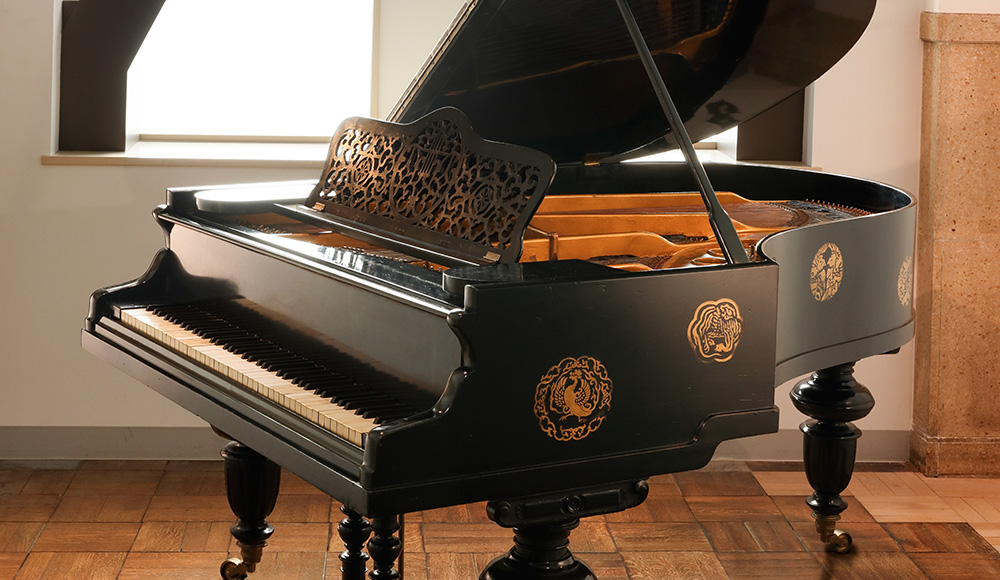
In a section of the Minato City Local History Museum is a musical instrument. Finished in black urushi lacquer, the piano is richly ornamented, featuring designs of phoenixes and long-tailed roosters in gold hiramaki-e lacquer on its sides, chrysanthemum arabesque patterns on its metal frame, and elegantly curved music stands and legs.
This grand piano is one of the earliest models of grand piano, manufactured in 1903 by Nippon Gakki Co., Ltd. (now Yamaha Corporation). Preserved over the years by members of the Imperial Family and the residents of Minato City, the instrument not only occupies an important place in the history of Japan's piano industry, but has also borne witness to the period in which Minato City advanced into the modern era.
In recognition of its historical value, it was registered as a Minato City Tangible Cultural Property in January 2002, and a Designated Cultural Property in October 2022. However, the passage of more than 120 years had inevitably taken a toll on the instrument, and it was showing clear signs of age and deterioration. Expert conservation work was needed to preserve it as a cultural property for future generations. To address this, Yamaha, the instrument's original manufacturer, partnered with the Crafts (Conservation) Studio, Graduate School of Conservation, Tokyo University of the Arts, a specialist in the conservation and restoration of cultural properties, on a joint conservation project.
![[Photo] The piano on display at the Minato City Local History Museum](/en/stories/culture/historical-piano-conservation/images/photo_01.jpg)
A Piano Cherished by the Imperial Family and the People of Minato City
Yamaha began manufacturing upright pianos in 1900 and grand pianos in 1902. This piano was manufactured during that early period in the company's history. Records confirm*1 that after being exhibited at the Fifth National Industrial Exhibition*2 in 1903, the piano was purchased by Empress Dowager Shoken and later presented to Empress Teimei. When Hikawa Elementary School was rebuilt in 1930, the Kujo family—the family of Empress Teimei, whose residence stood across from the school—donated the piano as a piano once played by the Empress Dowager.
With its ties to the Imperial Family, the piano became a treasured local asset and remained a familiar presence at the school for generations. After Hikawa Elementary School closed, it was displayed for many years at the Special Nursing Home for the Elderly "Sun-Sun Akasaka", which was built on the former grounds of the school. Following its registration as a Designated Cultural Property, the piano was relocated to the Minato City Local History Museum in 2023.
![[Photo] Students gathered around the piano at Hikawa Elementary School in the 1930s (Courtesy of Minato City)](/en/stories/culture/historical-piano-conservation/images/photo_02.jpg)
The Decision to Preserve the Piano as a Cultural Property Rather Than a Musical Instrument
"Preservation" can mean a variety of different things. One approach is to overhaul the instrument's internal components and return it to a playable condition. Another is to carry out extensive restoration to recreate its original appearance as closely as possible. Different objectives require different approaches.
To figure out the right approach for this piano, experts from a wide range of fields came together, including those from the Minato City Board of Education, Tokyo University of the Arts, and Yamaha's piano development team, as well as musicology and organology researchers and technicians specializing in instrument repair. They drew on their expertise, experience, and shared passion for the piano, and held extensive discussions. As they examined the piano, they found deterioration of the urushi lacquer finish, broken and missing wooden components, and worn parts. Numerous traces of past repairs also revealed the long history of the piano.
![[Photo] Experts examining the piano (Source: “Minato City Local History Museum Newsletter,” Vol. 20-1, Available only in Japanese)](/en/stories/culture/historical-piano-conservation/images/photo_03.jpg)
The question was how best to conserve a piano that had deteriorated so extensively. At the heart of this discussion was how to pass on this piano—a symbol of the Meiji era, a period of profound transformation in Japan—as a cultural property for future generations. The team ultimately chose a preservation-focused conservation approach based on cultural property conservation principles. The goal was to preserve the legacy of the Meiji era, when Japan embraced Western culture and sought to advance industry and arts through its own ingenuity and technical expertise. Rather than focusing on the piano's appearance or returning it to a playable condition, the approach sought to respect its current state as much as possible while preventing further damage. It also aimed to preserve the piano in a condition that would allow future conservation work to be carried out if needed.
Modern chemical coatings could restore the piano's lacquered exterior to a mirror-like shine. Replacing the strings and hammers could make it playable once again. Such extensive restoration, however, could also compromise the historical significance of the piano and its value as a cultural property.
The idea was to not erase the traces left by 120 years of history. And so they established their policy. Original parts and materials would be retained wherever possible, provided they would not affect the piano's long-term preservation. Damaged areas would be repaired as needed for safety, with an emphasis on reinforcement and conservation.
Two Areas of Expertise Behind the Conservation
A piano is a precision instrument made up of about 8,000 parts. Given its complex structure, responsibilities for the conservation were divided according to the work involved. Yamaha's piano development team was responsible for parts closely related to the piano's structure and mechanisms, including the body, music stand, action, and pedals. Meanwhile, restoration of the wooden components of the lid and legs, and the piano's urushi lacquer finish, were carried out by the team led by Tatsuya Matsumoto of the Graduate School of Conservation, Tokyo University of the Arts.
When conserving cultural properties, adhesives are not chosen based on strength alone. Modern synthetic adhesives may provide a stronger bond, but they can make future repairs more difficult or damage the cultural property through their chemical components. In recent years, there has been greater emphasis on reversibility (the ability to return an object to its original state) and long-term stability. As a result, it has become increasingly common to use traditional natural materials that are more compatible with the original materials. For this conservation, the team used mugi-urushi, a traditional adhesive made by mixing raw urushi lacquer with wheat flour. Team members worked under Matsumoto's guidance, bringing together their expertise in piano manufacturing and cultural property conservation.
![[Photo] At Yamaha Corporation's Kakegawa Factory; Yamaha staff reviewing the conservation work with Tatsuya Matsumoto of Tokyo University of the Arts (second from left)](/en/stories/culture/historical-piano-conservation/images/photo_04.jpg)
![[Photo] Tatsuya Matsumoto demonstrating how to prepare and use mugi-urushi](/en/stories/culture/historical-piano-conservation/images/photo_05.jpg)
Where major sections of individual components were missing, replacement wood was added using materials that closely matched the originals, while taking safety considerations into account. Cracks and lifting in the music stand were also bonded using mugi-urushi. The team also found unnecessary holes, likely created during past repairs, as well as cross recessed head screws that would not have been used when the piano was originally manufactured. Wherever possible, these areas were restored to their original specifications by filling the holes with matching wood and replacing the screws with slotted head screws. The strings, hammers, and felt, however, were not replaced. Instead, conservation was limited to cleaning to remove rust, dust, and other contaminants.
![[Photo] The severely damaged bottom panel of the pedal box](/en/stories/culture/historical-piano-conservation/images/photo_06.jpg)
![[Photo] Reattaching the wood using mugi-urushi](/en/stories/culture/historical-piano-conservation/images/photo_07.jpg)
![[Photo] The reconstructed bottom panel. Areas repaired with replacement wood were left about 0.5 mm thinner than the original, so that the conservation work can be identified in the future. The surface was subsequently lacquered by Tokyo University of the Arts](/en/stories/culture/historical-piano-conservation/images/photo_08.jpg)
![[Photo] Lifting of the music stand veneer](/en/stories/culture/historical-piano-conservation/images/photo_09.jpg)
![[Photo] Crack in the music stand](/en/stories/culture/historical-piano-conservation/images/photo_10.jpg)
![[Photo] Injecting mugi-urushi and clamping](/en/stories/culture/historical-piano-conservation/images/photo_11.jpg)
The piano, however, was in the delicate condition often seen with cultural properties—stabilized in a deteriorated state. Loosening screws or undertaking extensive disassembly could have caused movement within wooden components that had remained fixed for many years, potentially resulting in new damage.
For this reason, conservation work was carried out with the utmost care. And the process, which began in July 2024, was successfully completed in March 2025. The piano was then delivered to the Minato City Local History Museum and handed over to the team at Tokyo University of the Arts for the next stage: urushi lacquer restoration.
![[Photo] Delivered to the urushi lacquer restoration workshop set up in the back-of-house area of the Minato City Local History Museum](/en/stories/culture/historical-piano-conservation/images/photo_12.jpg)
Gentle, Careful Urushi Lacquer Conservation
The urushi lacquer conservation of this piano was not intended to return it to its original brilliance. Quite the opposite, in fact. It was undertaken to gently prolong the life of the lacquer layers that had deteriorated over time, while preserving the brushwork of the artisans who had created them. The work carried out by Tokyo University of the Arts began with a thorough cleaning. This process was essential for removing accumulated dust and grime and assessing the true condition of the urushi lacquer. Dust was carefully removed with kebo soft-bristled brushes, while dirt was gradually cleaned away using nonwoven cloths and cotton swabs moistened with purified water. Alcohol-based solvents or baking soda solutions were also used depending on the condition of the surface. However, in areas where the lacquer layer was thin or around the maki-e design, even the slightest friction could damage the design itself. Knowing when to clean and when to stop required constant and considerable judgment.
![[Photo] Matsumoto removing dust with a kebo soft-bristled brush](/en/stories/culture/historical-piano-conservation/images/photo_13.jpg)
![[Photo] Fine cotton swab used around the maki-e design](/en/stories/culture/historical-piano-conservation/images/photo_14.jpg)
Once the surface had been cleaned, the next step was urushi lacquer impregnation. This process protects and stabilizes deteriorated lacquer layers and those with fine cracks, by allowing diluted lacquer to penetrate the surface. Lacquer was applied with a brush, and any excess was carefully wiped away with nonwoven fabric. This process was conducted repeatedly, with the concentration of the urushi lacquer adjusted according to the condition of the lacquer layer and maki-e design, and continued until the piano had absorbed a sufficient amount of lacquer. Areas with cracks or missing material were further treated by filling them with a kokuso base material made from mugi-urushi mixed with wood powder, diatomaceous earth, and other materials. This reinforced the structure from within and helped prevent further deterioration.
![[Photo] Applying urushi lacquer with a brush](/en/stories/culture/historical-piano-conservation/images/photo_15.jpg)
![[Photo] Wiping away excess lacquer](/en/stories/culture/historical-piano-conservation/images/photo_16.jpg)
Apply lacquer. Wipe away. Wait for it to harden. Over the course of more than a year, these steps were repeated again and again, quietly restoring stability to the piano's urushi lacquer finish. The goal was not to bring back its original shine, but to ensure that no more would be lost. For the team at Tokyo University of the Arts, the urushi lacquer conservation became an exercise in working with the passage of time.
![[Photo] Side view of the piano before conservation](/en/stories/culture/historical-piano-conservation/images/photo_17.jpg)
![[Photo] Side view of the piano after cleaning and urushi lacquer restoration](/en/stories/culture/historical-piano-conservation/images/photo_18.jpg)
What the Piano Revealed
Following the principles of preservation-focused conservation, both teams avoided unnecessary intervention. Even so, the work led to a number of discoveries. One of them was the mark of a foreign manufacturer found on the action—the mechanism that transmits the movement of the keys to the strings, and is often described as the "heart" of the piano. The use of an imported part suggests that Yamaha, and Japan more broadly, had not yet reached the stage, in the Meiji era, where this complex mechanism could be manufactured domestically. Imported parts were also likely used for metal parts such as the pedals and strings. In addition, a handwritten signature—possibly that of the artisan who made it—was found on the keyframe, the frame that supports the action and keyboard.
![[Photo] The mark of the German manufacturer “L. ISERMANN HAMBURG,” found on the action](/en/stories/culture/historical-piano-conservation/images/photo_19.jpg)
![[Photo] Signature found on keyframe](/en/stories/culture/historical-piano-conservation/images/photo_20.jpg)
![[Photo] Signature appears to read “N, Yamaha”](/en/stories/culture/historical-piano-conservation/images/photo_21.jpg)
The metal frame that supports the strings bears the inscription, "YAMAHA PIANO Co." This suggests that the name had been carved into the mold before the frame was cast. But where was the frame actually made? Torakusu Yamaha traveled to the United States in 1899 and purchased machinery and parts needed for piano production*3. Research suggests that the frames used in the upright pianos Yamaha began manufacturing the following year, in 1900, were likely among those ordered during that trip. Unfortunately, however, it has not been possible to determine whether the frame for this piano was imported or produced in the Hamamatsu area. At the time, Hamamatsu's loom industry was developing, and the technological foundations for large-scale casting were beginning to take shape. If so, the possibility that this frame was produced in Japan cannot be ruled out.
![[Photo] “YAMAHA PIANO Co.” inscribed on the frame](/en/stories/culture/historical-piano-conservation/images/photo_22.jpg)
![[Photo] Traces of the words “Yamaha co.,” written in cursive, can also be seen on the underside of the fallboard](/en/stories/culture/historical-piano-conservation/images/photo_23.jpg)
There were other questions raised as well. There was urushi lacquer on the exterior, but could such lacquer work have been carried out in Hamamatsu at the time? Did local artisans have the technical expertise needed to bend the large, thick pieces of wood used for the piano's side panels? How was this piano assembled and lacquered? Questions like these are likely to provide valuable clues not only to the history of instrument making in Hamamatsu, but also to the study of Japan's industrial history. In fact, one researcher*4 began investigating the piano's lacquer finish and discovered that there had been a lacquer workshop in Hamamatsu. The finding sheds light on a little-known aspect of Hamamatsu's lacquer industry. The hope is that the piano will continue to serve as a catalyst for new historical discoveries.
Piano Returns to the Spotlight After Two Years
On May 1, 2026, nearly two years after the start of the conservation project, the grand piano made its return to the museum's gallery. Once again on display for visitors, its urushi-lacquered exterior stands out with a striking presence and craftsmanship. The piano will never sound again as a musical instrument. Yet it is precisely in that silence that visitors can sense its journey, from the Meiji-era exposition where it was first exhibited, to the Imperial House, and later to the school where it watched over generations of children. Now preserved as a cultural property, the piano will continue to tell its story to visitors—one that is intertwined with the history of Minato City and Japan's manufacturing and industrial development during the Meiji era.
![[Photo]](/en/stories/culture/historical-piano-conservation/images/photo_24.jpg)
![[Photo]](/en/stories/culture/historical-piano-conservation/images/photo_25.jpg)
![[Photo]](/en/stories/culture/historical-piano-conservation/images/photo_26.jpg)
About the Minato City Local History Museum
A facility where visitors can learn about, explore, and connect with Minato City through its nature, history, and culture. The building was originally built for the Institute of Public Health in 1938, and retains its appearance from that time. The piano is on permanent display in the former Library Director's Room next to the Communication Room on the second floor.
| Address: | Inside Yukashi no Mori, 4-6-2 Shirokanedai, Minato City, Tokyo |
| Admission: | Free |
| Hours: | 9:00 a.m. - 5:00 p.m. (until 8:00 p.m. on Saturdays) |
| Closed: | Third Thursday of each month (or the preceding day if it falls on a national holiday) and the New Year/year-end holidays (December 29 - January 3) |
![[Photo] Minato City Local History Museum](/en/stories/culture/historical-piano-conservation/images/photo_27.jpg)
- *1 "Minato City Local History Museum Newsletter," Vol. 14-1 (Available only in Japanese)
- *2 See "About the National Industrial Exhibitions"
- *3 Torakusu Yamaha, Journal of Travel to the United States (published by the Hamamatsu Historical Sites Research and Commemoration Society, March 1988; available through the National Diet Library Digital Collections)
- *4 Inoue, Satsuki 2025 “Lacquer and Early Japanese Piano Manufacturing, ca. 1900s” Journal of International Economic Studies 39, 185-207.
About the National Industrial Exhibitions
The National Industrial Exhibitions were expositions organized by the Meiji government to promote the development of Japanese industry. The Third National Industrial Exhibition, held in Ueno, Tokyo in 1890, garnered attention as the first venue in Japan to feature a streetcar operating on the grounds. Western musical instruments also began appearing at the exhibition, including organs by Yamaha founder Torakusu Yamaha, and products from other manufacturers. An American-made automobile was exhibited at the Fifth National Industrial Exhibition, held in Osaka in 1903, marking the arrival of a new era. The organ exhibited by Yamaha (then Nippon Gakki Co., Ltd.) received first prize, while its piano was awarded third prize. This piano received acclaim in Japan as well, and can be said to have played a role in the growing international recognition of Japanese industry.
![[ Thumbnail ] A 120-Year-Old Legacy — Project to Conserve Early Grand Piano for Future Generations](/en/stories/culture/historical-piano-conservation/images/bnr_historical-piano-conservation.jpg)
![[ Thumbnail ] Refining Yamaha's quality across departmental boundaries —From the French horn manufacturing site, returning to a customer-centric approach](/en/stories/culture/quality-through-dialogue/images/bnr_quality-through-dialogue.jpg)
![[ Thumbnail ] Education Outreach: Fostering the Next Generation of Musicians through a Life Filled with Music](/en/stories/culture/education-outreach-next-generation-musicians/images/education-outreach-next-generation-musicians-banner.jpg)
![[ Thumbnail ] The Power of Music to Connect Communities — New Possibilities for High School Band Clubs](/en/stories/culture/how-music-unites-communities-high-school-band-clubs/images/how-music-unites-communities-high-school-band-clubs-banner.jpg)
![[ Thumbnail ] The Joyful Piano](/en/stories/images/bnr_the-9th.jpg)
![[ Thumbnail ] Global LovePiano](/en/stories/images/bnr_lovepiano.jpg)
![[ Thumbnail ] School Project](/en/stories/images/bnr_school_project.jpg)
![[ Thumbnail ] Make and Play!](/en/stories/images/bnr_paperinstruments.jpg)
![[ Thumbnail ] I'm a HERO Program](/en/stories/images/bnr_im-a-hero.jpg)