
Measurement and Simulation of Aeroacoustic Phenomena in Bass Reflex Ports
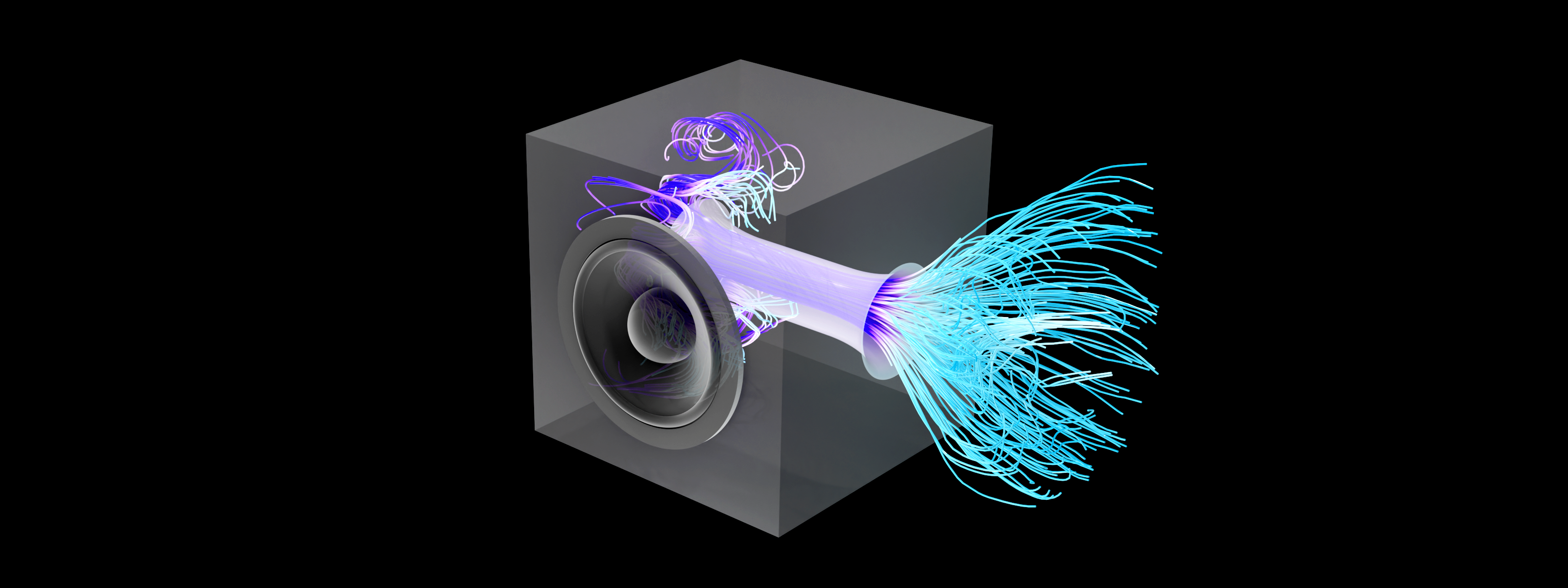
Port Noise in Bass Reflex Speakers
A bass reflex speaker, one of the many types of loudspeaker systems, incorporates a tube (or vent) known as a bass reflex port in the enclosure and utilizes the Helmholtz resonance phenomenon to enhance low-frequency response. Compared with simple sealed enclosures, bass reflex designs can reproduce deeper bass than would normally be expected from their relatively small cabinet volume. For this reason, they are widely adopted in speaker design.
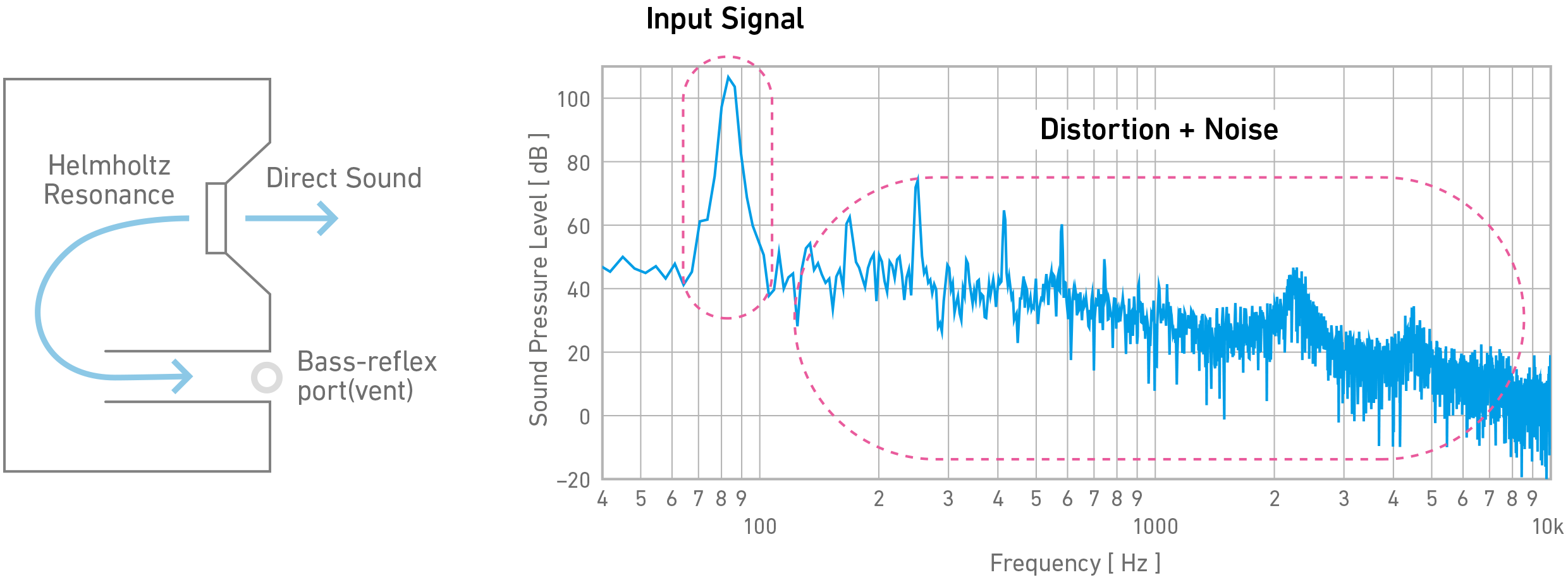
However, bass reflex systems also have disadvantages. When subjected to particularly large input signals, turbulence inside the port can generate audible noise, resulting in a decline in sound quality. Although manufacturers have proposed a wide variety of port designs to suppress such noise and improve sound performance, none has completely eliminated the issue. The reduction of port noise therefore remains a long-standing challenge for bass reflex speakers. Yamaha continues to introduce speakers that deliver clear, expressive bass reproduction while incorporating innovative design approaches to minimize port noise.
Here, we will introduce some of the advanced measurement and simulation technologies that support such proposals.
PIV Measurement to Visualize the “Vortices” that are the Source of Port Noise
Although the definition of port noise varies somewhat, in most cases it refers to what is commonly called “wind noise”. Within a bass reflex port, airflow occurs as acoustic particle velocity. During high-volume playback in particular, this airflow can reach typhoon-like speeds of tens of meters per second. At such high velocities, the airflow at the bass reflex port end cannot follow the shape of the wall surface and becomes detached, causing a pronounced phenomenon known as boundary layer separation. This separation generates vortices and turbulence, resulting in wind noise. Wind noise is classified as a type of aerodynamic sound, in which the airflow itself becomes the sound source. This phenomenon is related to the sound-producing mechanism of air reed instruments (such as recorders and flutes), and is therefore of particular relevance to Yamaha’s musical instruments and audio products.
Yamaha utilizes PIV (※) to visualize and measure airflow at the bass reflex port outlet, by observing the boundary layer separation and vortex behavior that cause port noise. This aids in understanding the mechanism and developing noise reduction techniques.
The following video shows an example of the velocity vector distribution obtained using PIV. You can see how the shape of the end of the port significantly alters the flow of air exiting the bass reflex port. It has been found that adding a radial profile to the end (rather than a simple vertical cut) results in smoother flow, suppresses vortex formation, and reduces port noise.
* PIV (Particle Image Velocimetry) is a method for measuring an air flow field. The target flow field is seeded with tracer particles (several micrometers in diameter) that are then irradiated with a high-intensity laser (Class 4). The flow velocity distribution can be visualized using a high-speed camera (tens of thousands of frames/second) that captures the movement of the particles illuminated brightly by the laser.

Fluid Acoustic Simulation for Observing Detailed Phenomena
Since there are limits to what can be observed in experiments, Yamaha is continuously conducting world-leading research and development. For such R&D, we utilize supercomputers to perform high-precision large-scale simulations—alongside measurements of actual phenomena such as PIV—while also relying on practical know-how and insights that are unique to us as a manufacturer.
When handling sound waves in fluid simulations, it is necessary to capture minute fluctuations in sound while simultaneously managing large-scale fluctuations such as flow, which requires massive computational power. Furthermore, since density waves like those for sound involve density fluctuations that correspond to variations in pressure, they must be treated as compressible fluids. This also involves internal flow, where the flow is significantly influenced by interactions with the wall surface. To capture such complex phenomena, Yamaha has developed technology that utilizes large-scale compressible fluid calculations to simulate sound waves in the time domain. This allows the accurate reproduction of port noise and observation of the airflow that causes it.
The following video shows an example of the results of fluid simulation. This is a one-quarter cut model of a cylindrical bass reflex port. It is used to visualize the Q-value (the second invariant of the velocity gradient tensor), which is an indicator of the vortex structure, and sound pressure. As resonance is excited, the flow velocity gradually increases, and a complex vortex structure develops. In addition to allowing the observation of detailed vortex structures that are difficult to measure directly, this approach allows prediction of wind noise caused by such flow disturbances.
Application to Twisted Flare Port Design
Yamaha’s proprietary Twisted Flare Port technology controls the turbulence that causes port noise. The twisted five-petal structure disperses vortex generation across time and space, which suppresses port noise in order to deliver clear, expressive bass reproduction. This design also utilizes the fluid simulation mentioned above, to optimize factors such as the number of petals and their twist angle.
Future Plans
In recent years, the rise of electronic music has led to an increase in music featuring deep bass tones that would be impossible to achieve with real acoustic instruments. The proliferation of DAWs has brought music production into the hands of individuals, leading to an increase in the demand for smaller speakers that are capable of reproducing bass frequencies. Therefore, speakers are now expected to deliver even better bass reproduction than before, and continuous technological innovation is required for bass reproduction technologies such as bass reflex ports.
Our mission is to flexibly adapt to these changes in how music is enjoyed and to continue providing new value and musical experiences. To do so, we use cutting-edge measurement and simulation techniques to address physical phenomena while pursuing fundamental value.