
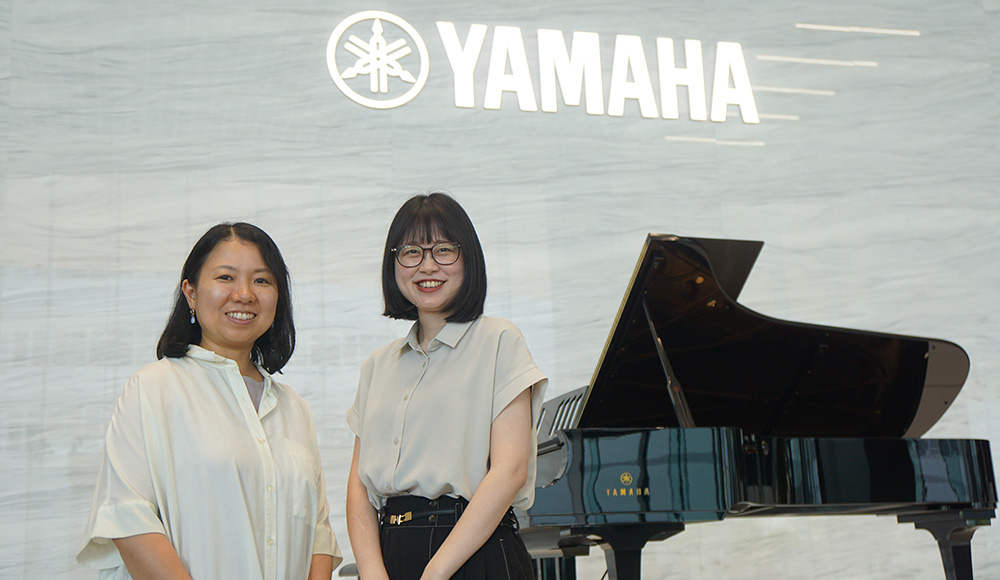
Toward an Organization Where Individual Differences Resonate: Challenges and Support as Seen from the Front Lines of DE&I Promotion
We spoke with members of Yamaha’s Human Resources Division who are working to promote DE&I (Diversity, Equity, and Inclusion). Coming from different career backgrounds, how do these two individuals approach the relationship between the organization and its employees as HR professionals, and what kind of environment are they striving to create? We take a closer look at the aspirations of this duo, whose vision is to “create an environment where people and organizations are empowered to take on challenges.”
- This interview article is a re-edited version of content originally produced for Cradle Inc.’s corporate website, adapted for use on Yamaha Corporation’s site.
About the Current Position and Mission
[Q] Please tell us about the area you are in charge of and your role within the organization.
Fujiwara: Within the Human Resources Strategy Planning Group, I am in charge of promoting DE&I. Within human resources, I see my role as not limited to areas such as recruitment and system implementation, but rather as one that takes a more cross-functional approach, looking at the organization as a whole.
Yamaha’s human resources department is divided into several functions; some organizations handle the so-called “offensive” aspects, such as recruitment and staffing, while others handle “defensive” functions, such as systems and compliance. Within that, our group takes a stance that is closer to “human resource development” or “organizational development,” and we are addressing the question of how the company as a whole can best utilize its people.
Over the past few years, the role of HR itself has been changing. We are currently in the process of transitioning from a function focused primarily on overall management and efficient operations to one that strategically brings out the potential of people and organizations and channels it into organizational contributions. In this process, themes such as human resource development, organizational development, and DE&I are starting to intersect.
I feel that our company is in the process of venturing into new territory, and within that context, I feel like I’m expanding my role through trial and error.
Liu: I’m also in charge of promoting DE&I in the same group, but my career path has been slightly different—I originally gained experience in more hands-on roles, such as customer service and marketing.
Later, I had the opportunity to get involved in an LGBTQ+ event, where I witnessed firsthand what it means to “be true to oneself.” It was an experience where I saw a side of people that we rarely see in everyday life—or rather, where I realized it was okay to just be our authentic selves so effortlessly.
Since then, I’ve come to want to support an environment where both I and the people around me can be more true to ourselves, which is why I got involved in the area of human resources.
[Q] How do you view your “mission as an HR professional”?
Fujiwara: I believe it’s about creating an environment where people feel empowered to take on challenges of their own accord.People often talk about taking on new challenges or about the importance of it, but I think it’s hard to do that on your own.
In the world of sports, even top-level athletes always have coaches and support staff, right? Even someone with that much talent doesn’t do it alone. They perform at their best with the support of those around them. I believe the same is true in the business world—challenges should, in principle, be undertaken with someone by your side.
That’s why I feel that, as HR, our responsibility isn’t just to say, “Do your best,” but to figure out how to create an environment where people feel empowered to take on challenges and how to support them in doing so.
Liu: If anything, I tend to focus on the small struggles that each person experiences in their everyday lives. For example, I believe that when people feel they have to conform to those around them or find it difficult to express their own thoughts—and these small feelings of dissonance and the small sacrifices they make keep piling up—they gradually lose their sense of self.
In an ideal world, I believe each person should be able to reach their full potential as their authentic self. To make that happen, I feel it’s necessary to gradually eliminate those small sources of struggle.
Fujiwara: You’re absolutely right. I think that creating an environment where people feel empowered to take on challenges ultimately comes down to how we can reduce those small daily feelings of dissonance.
While large-scale systems and structures are certainly important, I’ve come to realize once again that it’s even more important to truly understand how each individual feels and what circumstances they find themselves in.
Questions and Dissonance Currently Being Contemplated
[Q] Has there been any question or feeling of unease that’s been on your mind lately?
Fujiwara: Within our company, each division has its own culture and rules. It is sometimes described as a gathering of small and medium-sized enterprises. I believe that each area has its own history and legacy, and that these are valuable in and of themselves.
However, I feel that in such an undercurrent of unspoken expectations, there may be situations where it becomes difficult to voice one’s dissonance, despite feeling it.
How can we preserve what we’ve built up over the years while also harnessing that sense of dissonance to fuel our growth?
I’m still trying to figure out how to strike that balance.
Liu: Since joining the Human Resources and General Administration Division, I’ve been receiving more one-on-one consultations, but there are cases where, aside from listening, I can’t offer a solution at this point, which makes me feel frustrated.
[Q] What kind of events or circumstances led you to feel that way?
Fujiwara: There are many situations in everyday life where you can sense the differences between divisions. For example, even when looking at the same thing, the way it’s expressed can be completely different.
In one division, something described as a “round sound” might be described using completely different expressions in another division, leading to situations where people don’t understand what each other is talking about.
I think that’s part of what makes Yamaha so interesting. It is precisely because there is such a diversity of sensibilities that great value is created. At the same time, it is precisely because of these differences that there are times when it becomes difficult to understand one another.
I feel that it won't be easy to figure out how to navigate between these two aspects.
Liu: What really sticks with me are the interactions and surveys that take place after seminars and events. While there is a lot of positive feedback about the content, some people find themselves in unique situations where standard solutions do not apply.
While DE&I focuses on socially marginalized groups, the more I learn, the more I become aware of the existence of unrecognized minorities, and I think every day about ways to reach out to them as well.
Organization Culture and Work Environment
[Q] What kind of culture do you feel the organization has right now?
Fujiwara: I feel that this is an organization where each division has its own culture and set of rules. Given the high level of specialization, I get the impression that the values and practices cultivated within that area are deeply ingrained.
I believe that in and of itself is a tremendous strength, and I feel that it is precisely because of that accumulated experience that our current business and products are able to thrive.
Meanwhile, I sometimes wonder if the fact that each division has such a strong culture of its own might actually make it harder for connections to form between divisions. Rather than saying one is good and the other is bad, I see it as a situation where both sides exist.
Liu: That is true. However, I also feel that these diverse elements don’t necessarily intersect, but rather exist independently in their own respective spaces. So, my current impression is that, while there is diversity, the various elements are not yet fully connected.
[Q] Are there any areas where you think, “I’d like to change this” or “I want to preserve this”?
Fujiwara: I want to preserve the culture and expertise we have today just as they are. I also feel that, since it’s something that has been cultivated over a long period of time, it shouldn’t be changed lightly.
Building on that, I’d like to create an environment where we can connect across boundaries a little more.
I don’t think we need to become completely one, but I believe the ideal relationship is one where we understand each other’s differences, maintain a loose connection in our daily lives, and can rely on each other when necessary.
Liu: I also believe it’s important to learn how to interact with others while acknowledging that we are all different. I think just being able to imagine that there are people in situations different from your own can change the way you interact with them.
I feel that as that mindset gradually spreads, we’ll get closer to a point where we can work together without having to stretch ourselves to conform.
Examples of Actual Initiatives
![[Photo]](/en/stories/social/dei-workplace-challenges-and-support/images/photo_01.jpg)
[Q] Please tell us about the measures and systems your organization or team is currently implementing.
Liu: We have several initiatives in place, such as seminars on caregiving, LGBTQ+ initiatives, and events both inside and outside the company. As we’ve actually been working on these initiatives, we’ve come to realize how difficult it is to prevent these topics from being perceived as “something meant for a specific group of people.”
I had the feeling that while it reached those who were interested, it was hard to get through to those who weren't. As a result, I’ve started to focus on choosing topics and communication styles that resonate with as many people as possible, so that they feel it’s relevant to them, too.
Fujiwara: I make a conscious effort to reach out to external partners rather than limiting our initiatives to within the company. I feel that going out into the world, encountering people, things, and experiences that are different from our everyday lives, and using our sensibilities to connect with them and exchange opinions, deepens our understanding.
There is, after all, a difference between simply knowing something intellectually and experiencing it firsthand, so I place great importance on how to design for both. As part of these initiatives, with the aim of fostering the growth of individuals and organizations through engagement with external stakeholders, members of the executive team and division heads attended the International Women's Day Leadership Forum 2026, held in Yokohama on March 10, 2026.
Through workshops and discussions with a diverse group of participants, it was an opportunity to consider the future of leadership and the structure of organizations while engaging with perspectives from different standpoints and backgrounds.
Yamaha also hosted a breakout session centered on the theme, “What can individuals and organizations do to help people continue to thrive as their authentic selves even as they navigate life events?” and conducted a workshop that allowed participants to experience this concept through sensory engagement.
We aim not only to absorb knowledge and insights from outside sources, but also to share with society the initiatives that only Yamaha can undertake, thereby giving back to society in the form of value.
[Q] What was the background and purpose of this initiative, and what did you prioritize in its design?
Liu: People sometimes feel that DE&I initiatives aren’t relevant to them. For example, initiatives to promote women’s participation in the workforce can sometimes feel distant to people who aren’t directly involved.
As a result, it can sometimes be difficult for its message to get through.
Based on that experience, I believe that caregiving is one of those issues that anyone can find themselves facing. It’s a topic that has the potential to affect many people, regardless of their age or circumstances.
Fujiwara: From a design perspective, I make a conscious effort not to stop at simply learning about it. While it’s important to understand it as information, I feel that if that’s all there is to it, it’s hard to make it feel personally relevant. I believe that there are some aspects that can only be fully understood once you’ve actually experienced them or formed a concrete mental image of them.
[Q] Regarding internal reactions, results, and any innovative approaches
Liu: What struck me about the caregiving seminar was that the number of participants exceeded expectations. I hadn't realized this was a topic that interested many people, so that in itself was a revelation.
Content-wise, there was a lot of information that differed slightly from mainstream thinking. For example, there was a point made that families shouldn't have to shoulder the burden all on their own.
Some people said that being exposed to that way of thinking had shifted their perspective slightly. One point the instructor repeatedly emphasized during the seminar was the importance of reaching out for advice first. Even if you don't know where to start, I believe that simply knowing where to turn for advice makes it easier to take action.
Fujiwara: When designing events, we also make a conscious effort to make them as inclusive as possible. We’re making it easy not only for people who are already highly interested but also for those who are just slightly curious to get involved, and we’re creating pathways so that even people who participate for other reasons end up learning about it as a result.
Liu: In fact, I feel there are many cases where people who weren’t particularly interested at first end up participating and learn about it for the first time during the event. I’d like to continue thinking about how to create such entry points.
Fujiwara: Thanks to these events, I’ve been getting more and more opportunities for people to reach out to me. I also feel that this has led to subsequent dialogues.
Signs of Small Changes
![[Photo]](/en/stories/social/dei-workplace-challenges-and-support/images/photo_02.jpg)
[Q] Are there any experiences from your daily life where you felt signs of culture taking root?
Liu: Perceptions of DE&I may be changing, albeit very gradually. Until now, I think it was generally perceived as something intended for specific people, but through these caregiving seminars, there have been more and more opportunities for people to see it as something that could also happen to them.
Fujiwara: That is true. I get the sense that the idea that anyone could find themselves in this situation, rather than it being about a specific person, is gradually gaining traction.
Because of that, I’ve noticed a shift—people who previously had no interest in the topic are now listening to what I have to say and starting to think of it as something personally relevant.
Liu: I think being approached by people after an event is one of the changes I’ve noticed. I felt that stories that had rarely come to light until then were gradually beginning to be put into words.
[Q] What emotions or thoughts did you have the moment you realized that?
Liu: That made me happy. At the same time, though, this is still just a small part of it, so I hope it reaches even more people going forward.
Fujiwara: I feel the same way—I can sense some progress, but I still feel like we’re only halfway there. It takes time for something to become deeply rooted as part of the culture, and it’s not something that can be changed through a single initiative. That’s exactly why I’m once again realizing how important it is to continue promoting these initiatives.
Obstacles and Conflicts to Overcome
[Q] Are there any aspects of organizational culture or values that you find challenging or conflicting?
Liu: In my work in human resources, there are times when I feel the limits of what I can do. Some of the inquiries we receive can be addressed through existing systems and structures, while others cannot.
In many cases, even after listening to someone’s story, I can’t immediately change the situation, and I sometimes find that challenging. Although I really want to help, there are limits to what I can actually do. I'm navigating this reality feeling both of those things.
Fujiwara: I think it’s a major factor that, due to the organization’s structure, there are some things that can’t be changed immediately. Because there are so many people involved and the scope of the impact is so broad, not everything can be changed significantly by a single decision.
When addressing specific challenges within that context, there are inevitably situations where I find it difficult to respond effectively.
Liu: In particular, when I hear from people who are facing significant personal burdens or struggles, it makes me wonder how deeply I can get involved. While I can refer people to the appropriate department or explain the relevant systems as needed, that alone often isn’t enough to resolve the issue, which can be frustrating.
[Q] How are you planning to overcome that? Are there any sources of support or strategies you use?
Liu: There are many issues we can’t resolve right away, but that’s exactly why I believe it’s so important to communicate to people that we are on their side. I strive to listen attentively and respond sincerely, in the hope of providing even a little emotional support to those who come to me for advice. With that in mind, I’m doing the best I can with the support of those around me.
Fujiwara: I, too, make a conscious effort not to try to solve things on my own. I believe that one of my roles is not only to provide answers on the spot, but also to connect people with the right individuals or structures, and I feel that this often leads to continual support in the long run.
I also believe it’s important to consider how we can create a situation where people don’t have to shoulder the burden alone in the first place.
What to Foster Going Forward
![[Photo]](/ja/stories/social/dei-workplace-challenges-and-support/images/photo_03.jpg)
[Q] What kind of well-being would you like to foster—both for the organization and for yourself—going forward?
Fujiwara: I believe that rather than creating something new and special, continuing to confront the dissonance and challenges we currently face will, in and of itself, lead to well-being. The ideal future is one in which workplaces gradually become more inclusive, allowing each person to work without overexerting themselves and stay true to who they are.
I would like to create an environment where these issues are not isolated as individual challenges, but are addressed by the organization as a whole.
Liu: Likewise, rather than trying to build the ideal world all at once, I believe it’s important not to ignore the small daily feelings of dissonance or struggle that people experience.
I feel that by gradually removing those elements, we can ultimately achieve results that create more opportunities for people to stay true to themselves.
[Q] Are there any challenges you’d like to take on going forward, or any values you’d like to preserve?
Fujiwara: I believe that one of the key themes for the future is how to broaden our understanding—not just through knowledge, but also by increasing the insights we gain through experience.
I believe that personal experiences are more likely to lead to action, so I want to focus on how to create such opportunities.
Liu: Up until now, I’ve tended to focus more on challenges and struggles, but I’d like to convey not just those aspects, but also the warmth and sense of connection.
In addition to understanding the challenges, I believe that having experiences that allow people to realize alternative ways of engaging with the issue will help them accept it more readily.
Interviewees
![[Photo] Mai Fujiwara](/ja/stories/social/dei-workplace-challenges-and-support/images/photo_04.jpg)
Mai Fujiwara
Yamaha Corporation Human Resources and General Administration Division Human Resources Strategy Planning Group Manager
Joined Yamaha Corporation as a new graduate in 2007. She has worked in the Research & Development Division on the technical development and management of kansei engineering. Inspired by her studies in organizational development during her parental leave in 2019, she broadened the focus of her career to supporting the growth of people and organizations, and has been involved in advancing research from both the perspectives of technology development and organizational development. Starting in 2025, she has been responsible for company-wide organizational development in the Human Resources Division. Drawing on her background as an engineer, she leads Yamaha’s unique DE&I initiatives. She is committed to building an organization that empowers everyone to realize their full potential authentically, while achieving a balance between taking on challenges and having a sense of security.
![[Photo] Joyi Liu](/ja/stories/social/dei-workplace-challenges-and-support/images/photo_05.jpg)
Joyi Liu
Yamaha Corporation Human Resources and General Administration Division Human Resources Strategy Planning Group Assistant Manager
Joined Yamaha Corporation as a new graduate in 2019. She was responsible for customer success in both the Quality Assurance Division and Marketing Division. Inspired by her participation in Tokyo Pride—one of Japan’s largest LGBTQ+ events—in 2023, she developed a growing interest in DE&I initiatives that support each individual’s authenticity. In 2025, she transferred to the Human Resources and General Administration Division through the company’s internal job posting system and took on the role of promoting DE&I. She is committed to promoting DE&I under the motto of “working together to create a world where everyone, including our employees, can live authentically.”
Social latest article
Toward an Organization Where Individual Differences Resonate: Challenges and Support as Seen from the Front Lines of DE&I Promotion
We spoke with members of Yamaha’s Human Resources Division who are working to promote DE&I (Diversity, Equity, and Inclusion). Coming from different career backgrounds, how do these two individuals approach the relationship between the organization and its employees as HR professionals, and what kind of environment are they striving to create? We take a closer look at the aspirations of this duo, whose vision is to “create an environment where people and organizations are empowered to take on challenges.”
Nurturing Future Talent Through Music Education and Strengthening Local Communities: The Challenge of Spanish Public Schools and Yamaha
In recent years, the role of music education in human development and its impact on society has attracted growing attention across the fields of education and science.
Related Projects
Diversity, Equity & Incusion