
Loudspeaker Nonlinear Distortion Control Technologies
Delivering Sound with Fidelity
In speakers and headphones, distortion occurs because the reproduced sound cannot perfectly match the input signal during the process of converting electrical signals into sound. This distortion can appear as muddiness or unnaturalness, affecting the clarity and naturalness of the reproduced sound. Yamaha’s nonlinear distortion control technologies are designed to reduce this distortion through advances in materials, electrical circuitry, and signal processing, enabling the expression contained in the source material to be reproduced more accurately and naturally.
Distortion in Audio Equipment
In audio equipment, distortion occurs when electrical or magnetic response, or the movement of the diaphragm, deviates from ideal behavior. Such distortion can lead to muddiness, unstable imaging, and reduced definition in the low-frequency range, affecting the clarity and naturalness of the reproduced sound.
To address these issues, Yamaha is developing multiple technologies tailored to the underlying causes of distortion. The following sections introduce technologies that reduce distortion arising from electrical and magnetic factors, as well as distortion associated with diaphragm motion.
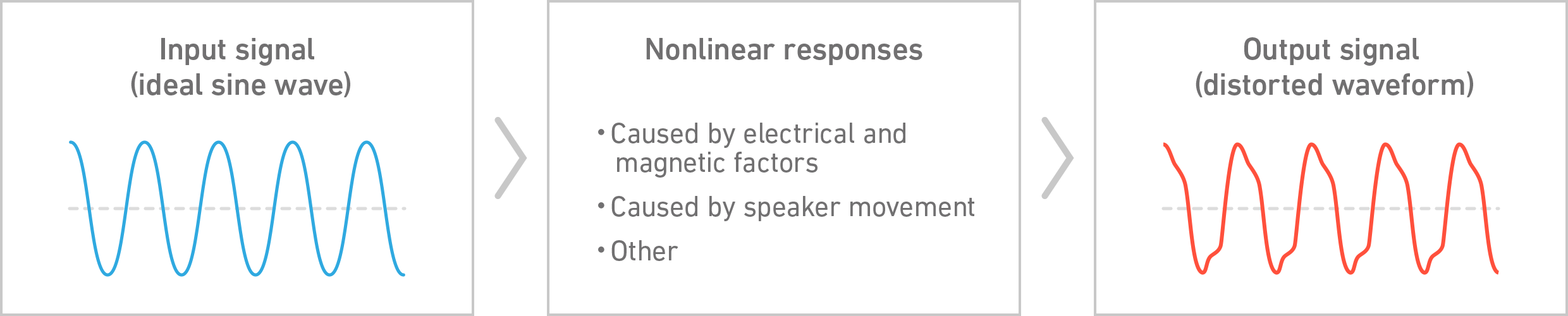
1. Distortion Caused by Electrical and Magnetic Factors
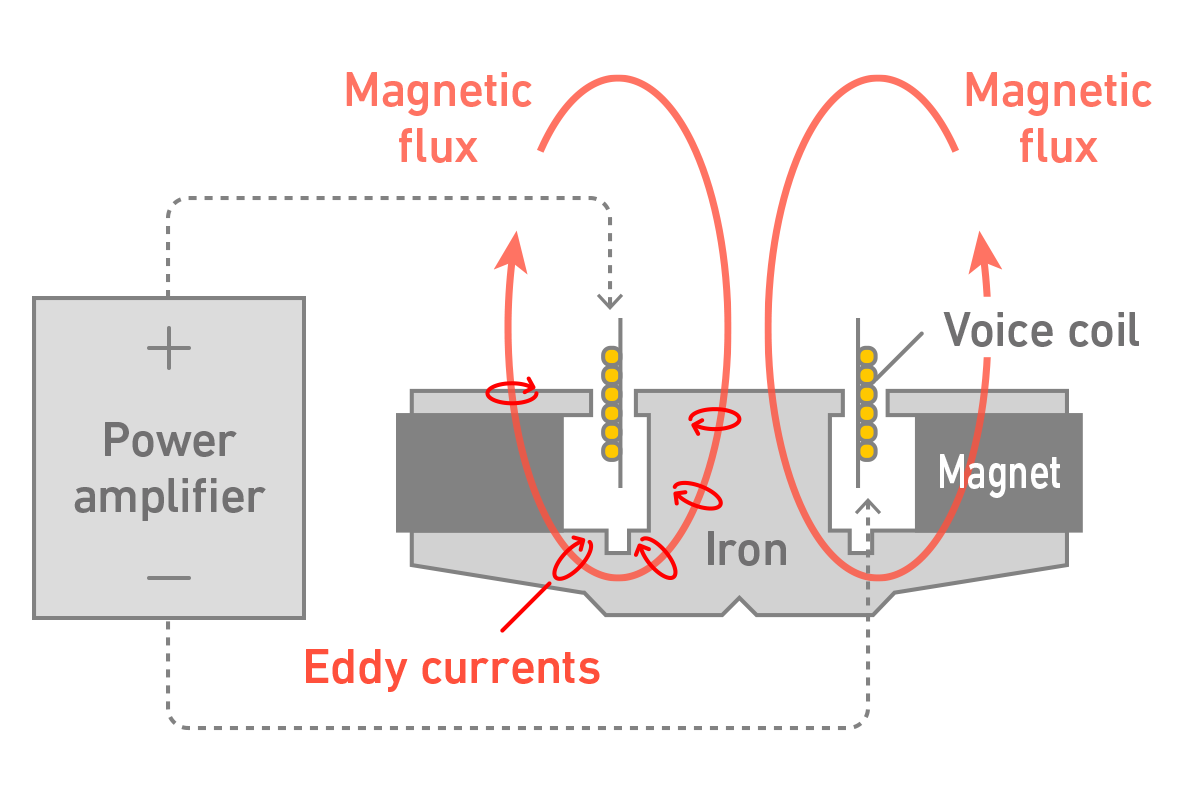
In conventional audio systems, the power amplifier is designed as an ideal voltage source, and the speaker is driven by its output. Inside the magnetic circuit of a speaker unit, however, changes in magnetic flux generate eddy currents in magnetic materials (iron). These eddy currents produce magnetic fields that oppose the original flux variations, altering the characteristics of the magnetic circuit depending on the driving conditions. As a result, nonlinear variations occur in the speaker impedance, causing the current flowing through the voice coil to deviate from the input signal. This current distortion ultimately appears as distortion in the reproduced sound.
1-1. Distortion Reduction Using Magnetic Materials and Magnetic Circuit Design
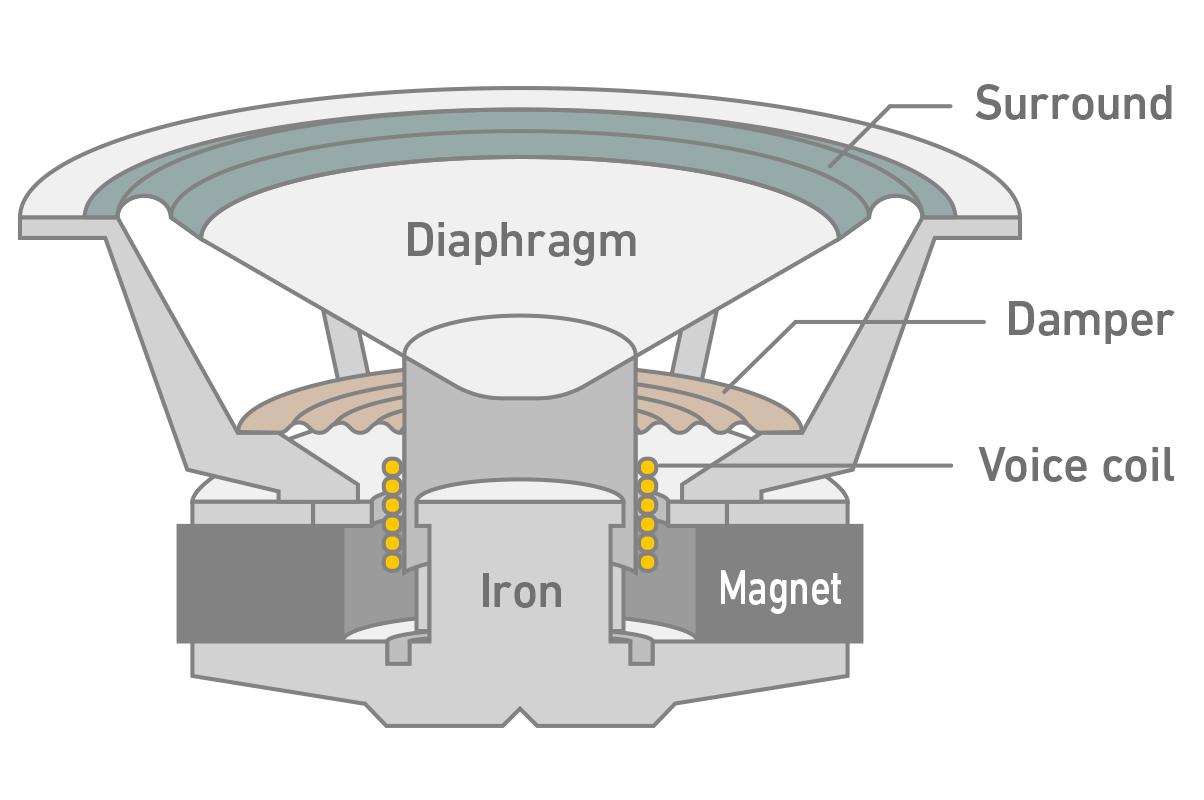
This technology focuses on the magnetic circuit that drives the diaphragm in speakers and headphones, reducing distortion through a combination of materials engineering and magnetic circuit simulation. These circuits use magnetic materials such as magnets and iron, and reproduce sound by moving the diaphragm through the interaction between the current flowing through the voice coil and the magnetic field.
Eddy currents generated within magnetic materials cause nonlinear responses in the magnetic circuit and can increase perceptually significant third-order distortion components, which appear at three times the frequency of the input signal. To suppress this distortion, Yamaha is exploring magnetic materials that are less susceptible to eddy currents, such as soft magnetic composites (SMC). In addition to material properties, we are evaluating practical reliability factors such as surface protection and dimensional stability.
Yamaha also uses magnetic circuit simulation to visualize the distribution of magnetic fields and eddy currents, and to evaluate how different magnetic materials and circuit structures affect distortion. Because the internal behavior of magnetic circuits is difficult to fully understand through prototypes alone, simulation enables quantitative comparison of material and structural differences.
The figure below shows an example of eddy-current distribution and third-order distortion evaluation for iron and soft magnetic composite (SMC). By visualizing how eddy currents are generated and how they influence distortion, Yamaha uses magnetic circuit simulation to quantitatively compare differences in materials and structures and apply the results to low-distortion magnetic circuit design.
By combining materials development with magnetic circuit simulation, Yamaha aims to realize audio equipment that delivers high sound quality with reduced distortion.
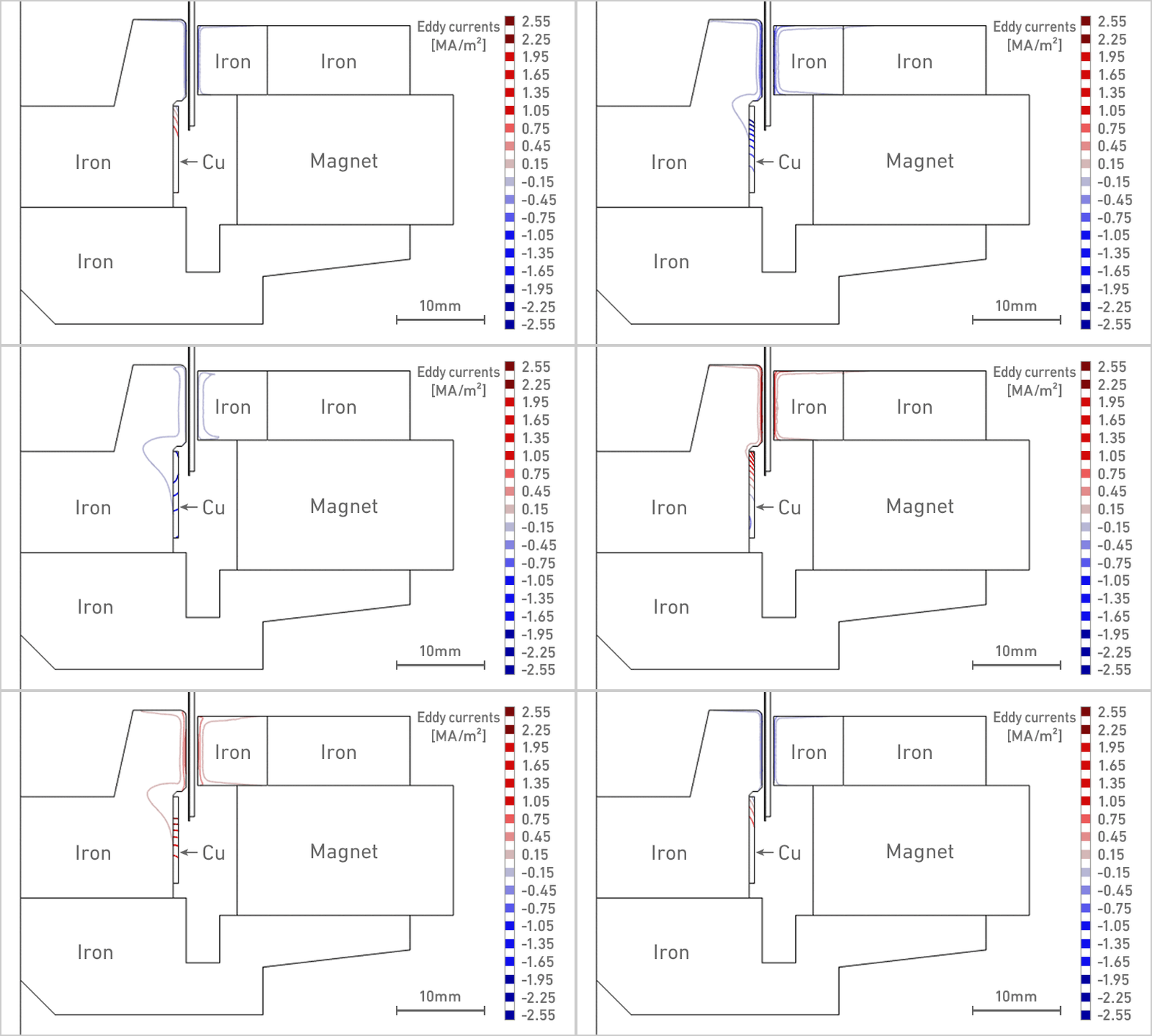
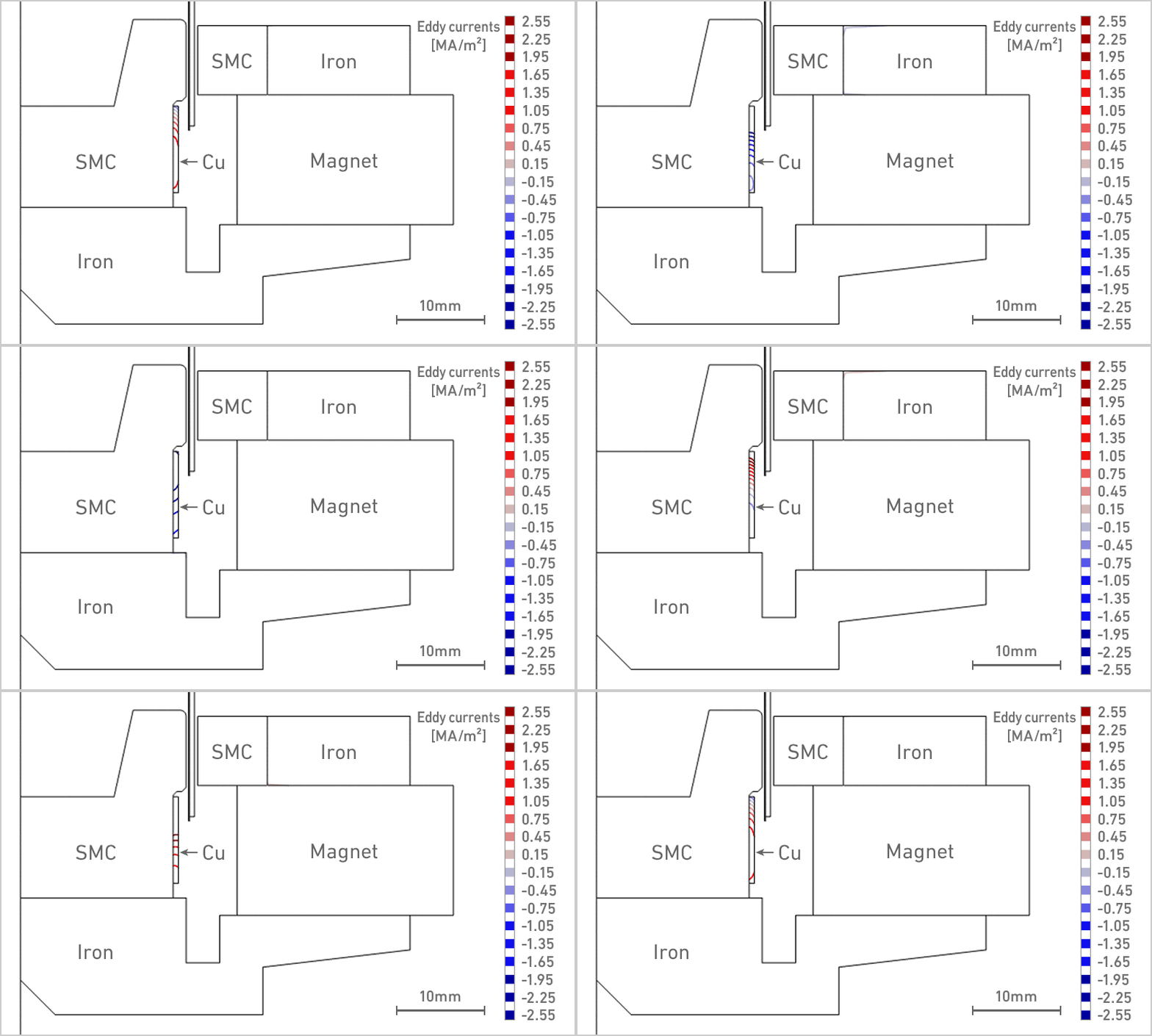
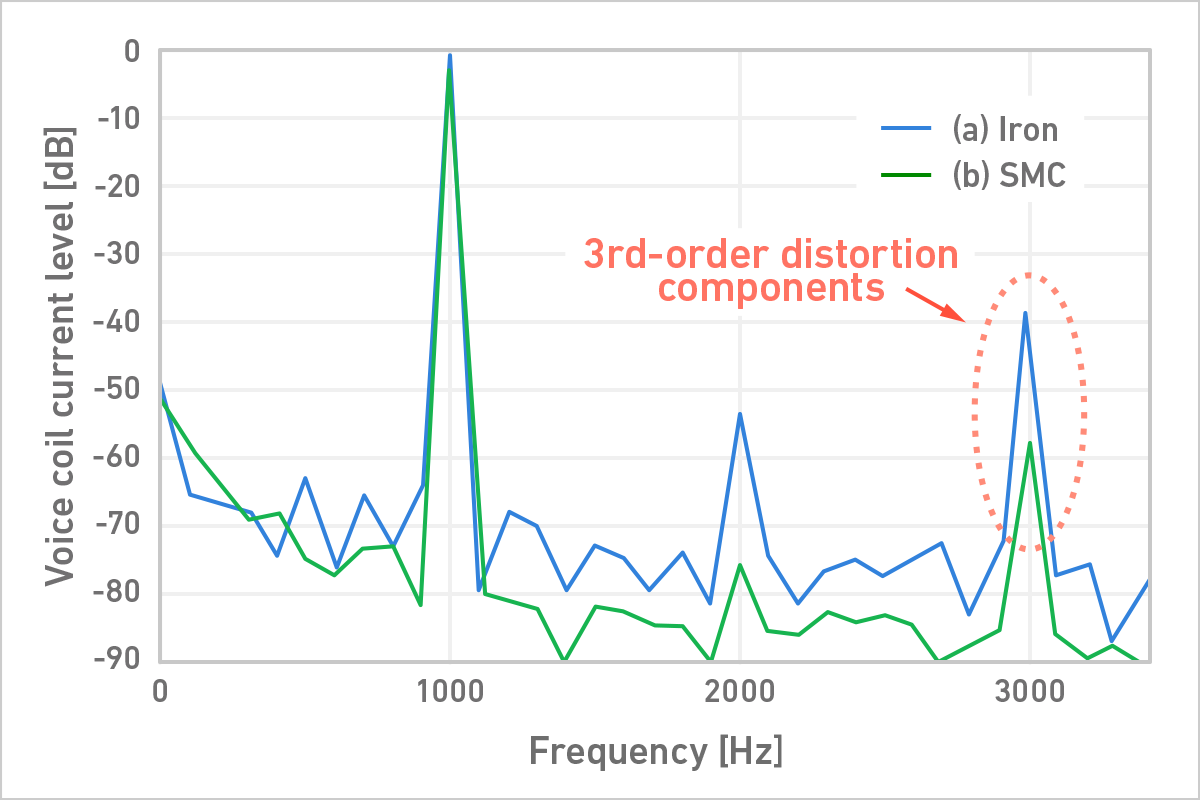
Comparison of eddy currents and 3rd-order distortion components in magnetic circuit materials
(Analysis conditions: Input voltage 2 Vrms, input frequency 1000 Hz)
1-2. Distortion Reduction Using Electrical Circuit Design
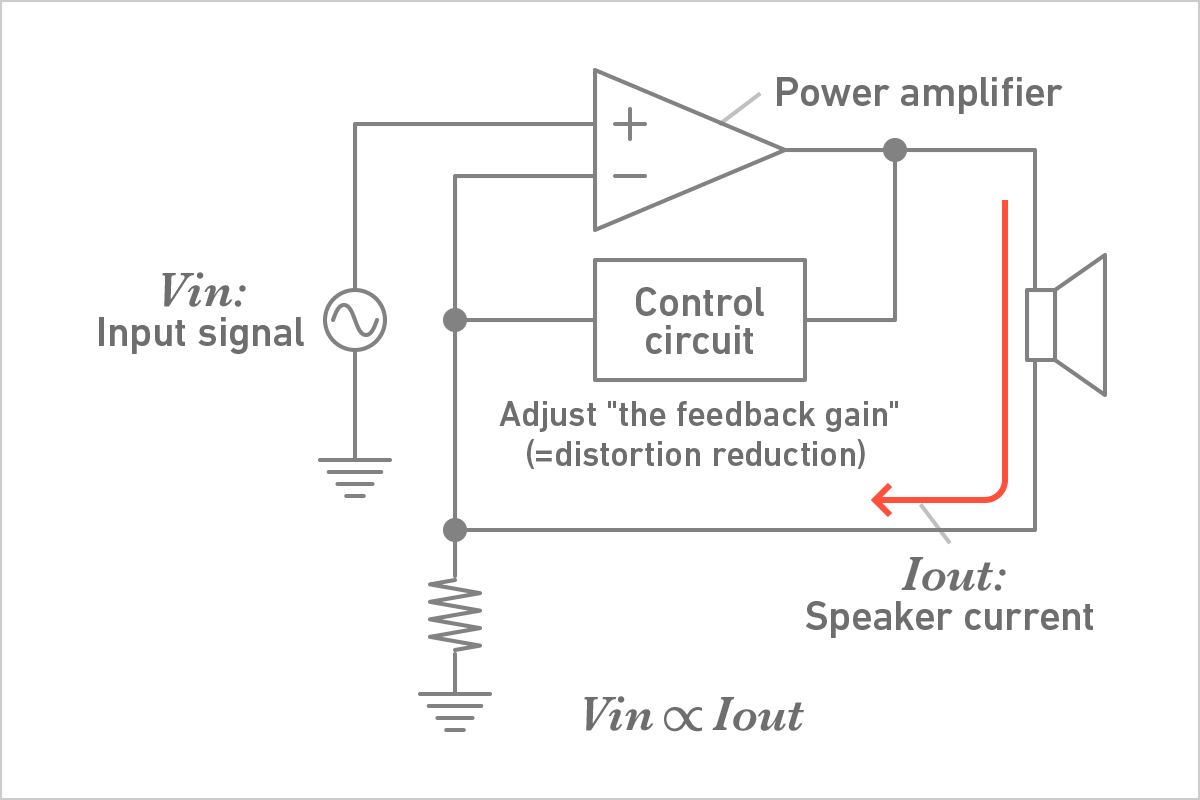
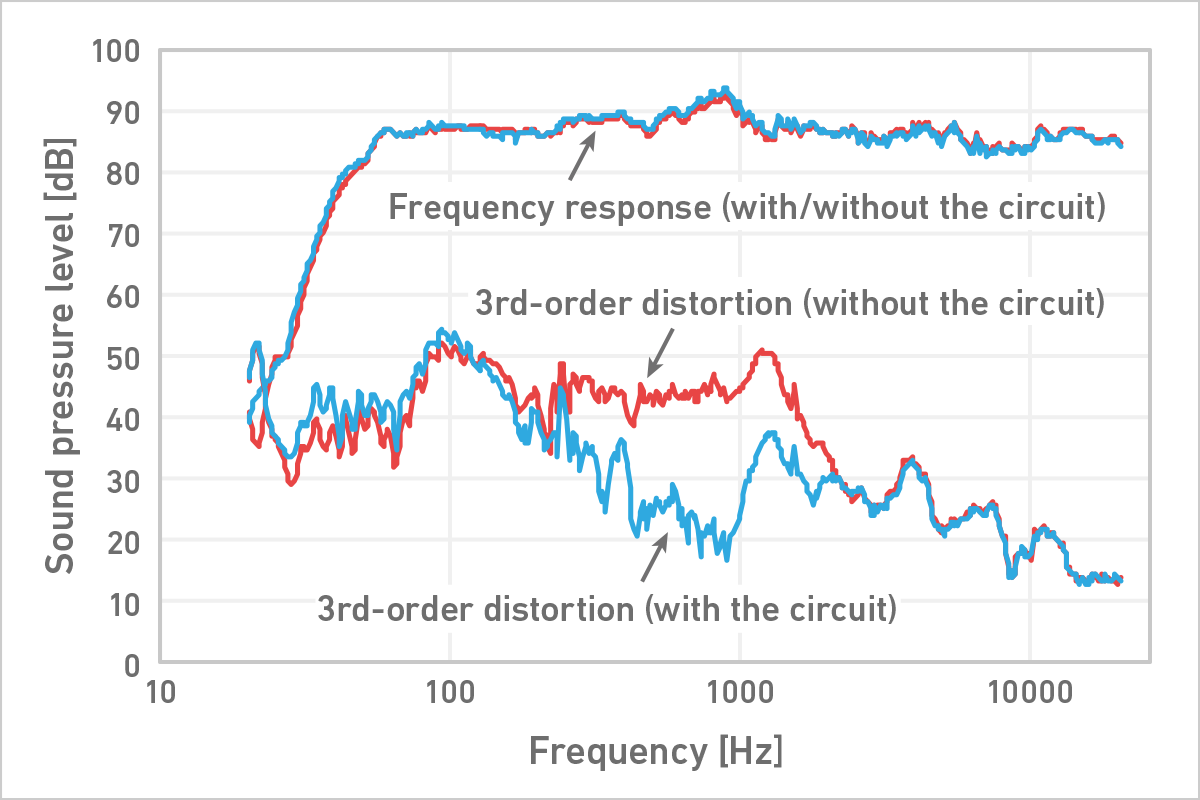
This technology reduces current distortion caused by the speaker’s magnetic circuit across a wide frequency range by accurately controlling the voice-coil current. Because the voice-coil current directly determines the speaker’s driving force, keeping it close to the ideal waveform reduces distortion. A current-feedback circuit continuously monitors the current and corrects any deviation from the input signal. As a result, an accurate current waveform is maintained even in the presence of magnetic effects such as eddy currents, reducing distortion.
Another advantage of this approach is that it can be implemented without special materials, requiring only a small number of additional electronic components. Measurements of acoustic distortion have confirmed distortion reduction across a broad frequency range from 200 Hz to 3 kHz, with improvements of up to approximately 20 dB.
By reducing distortion in this way, the technology enables clear and faithful sound reproduction while also improving sound imaging, spatial realism, and the texture of reverberation.
2. Distortion Caused by Diaphragm Motion
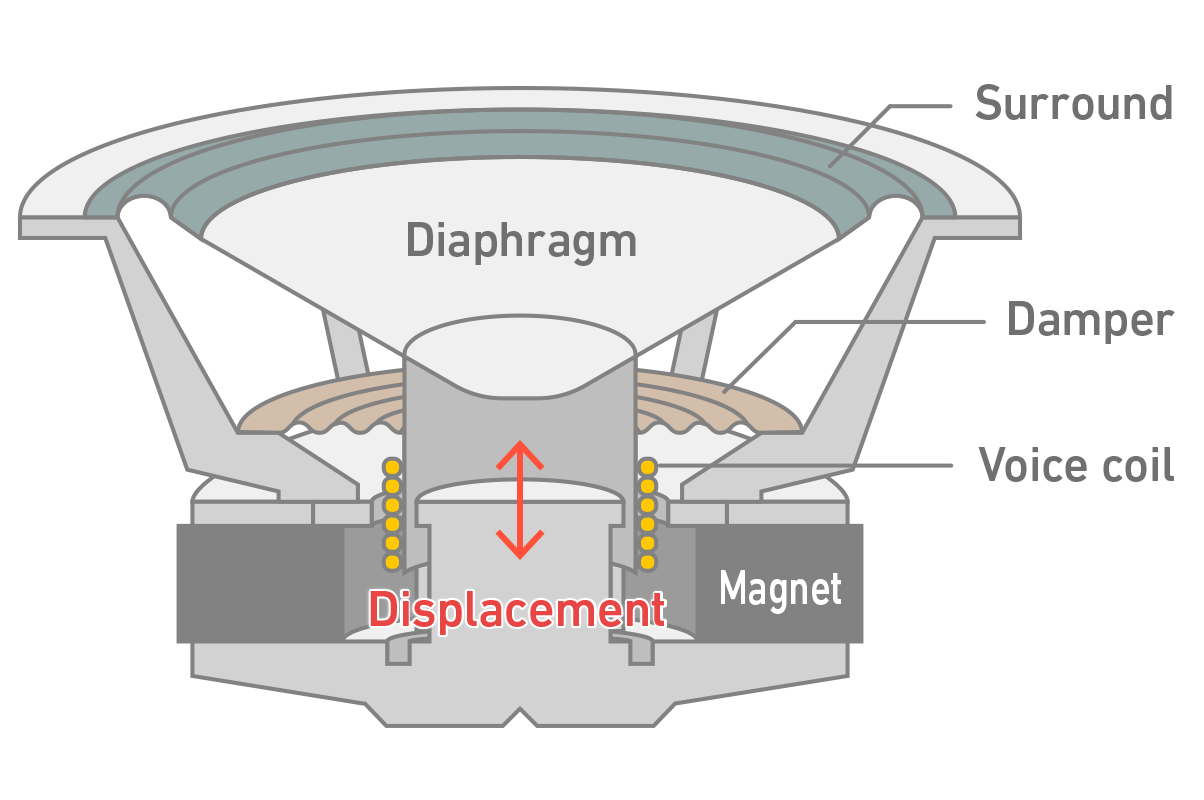
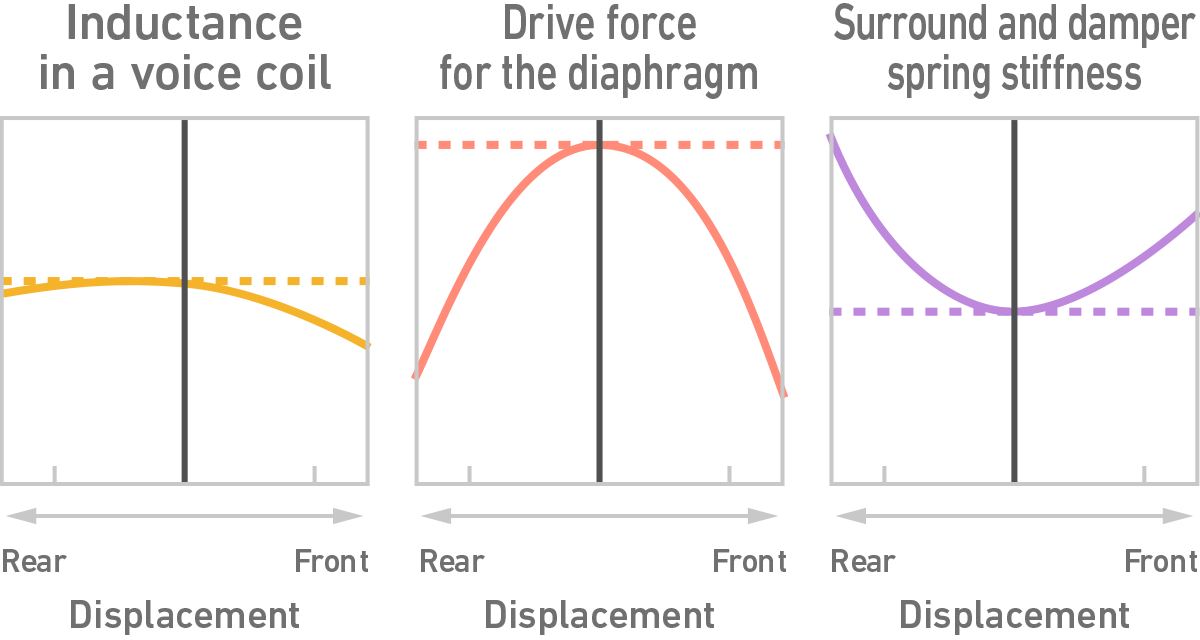
Speakers produce sound by moving a diaphragm back and forth in response to an electrical input signal. When the diaphragm movement is small, it can follow the input signal relatively accurately. However, when reproducing low-frequency sounds at high levels, where the diaphragm moves over a larger distance, the driving force acting on the diaphragm and the restoring force of the supporting components become less uniform. As a result, the diaphragm can no longer follow the input signal precisely, causing deviations in the reproduced waveform. These deviations appear as distortion, reducing sound definition and clarity.
2-1. Distortion Control Using Signal Processing
This technology uses DSP-based signal processing to correct distortion caused by nonlinear speaker motion. By improving how accurately the diaphragm follows the input signal, it reduces low-frequency distortion and enables more natural, articulate sound reproduction. It also enhances bass definition and attack, making fine details easier to hear. By stabilizing speaker behavior and helping maintain sound quality even at high output levels, the technology contributes to the reliability and acoustic performance required in professional environments.
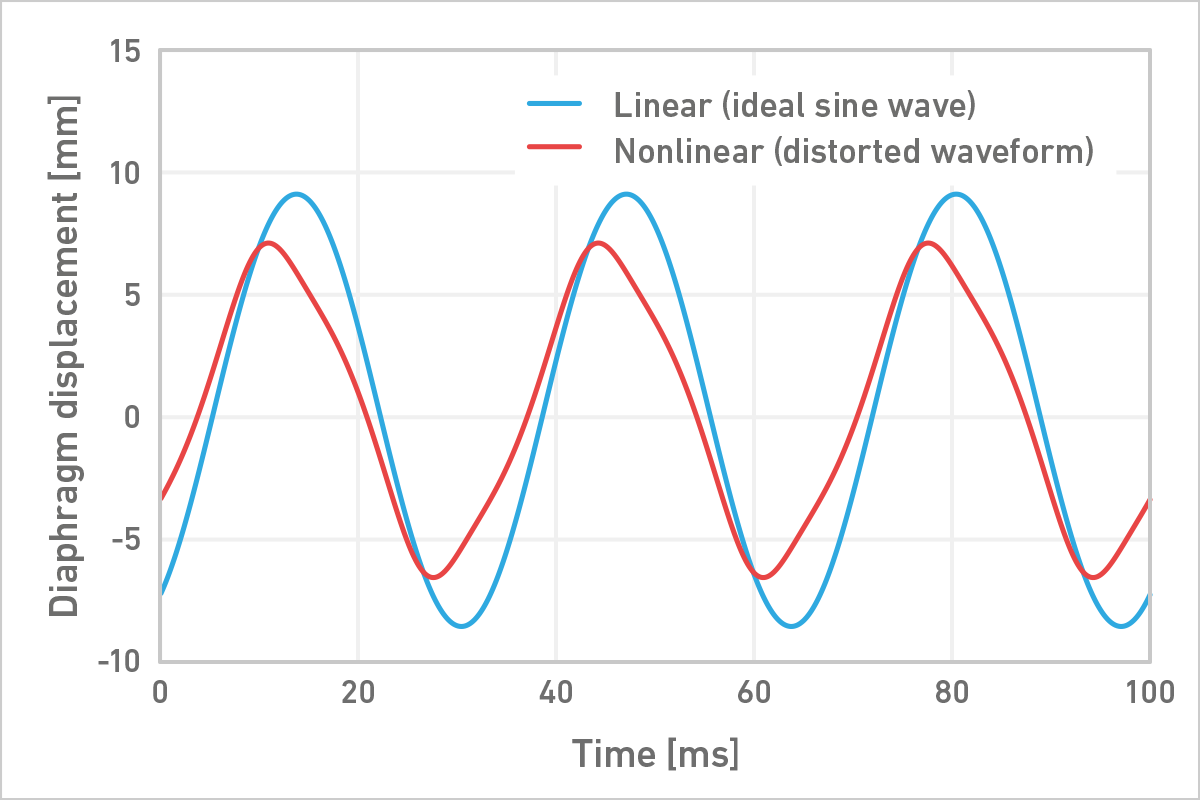
This graph shows speaker displacement over time in response to an input signal. The horizontal axis represents time, and the vertical axis represents speaker displacement. The blue line indicates an ideal linear sine wave that faithfully follows the input signal, while the red line shows a waveform distorted by the speaker’s nonlinear characteristics. In a nonlinear state, each characteristic changes according to diaphragm displacement, causing deviations in amplitude and waveform shape. These deviations appear as distortion in the reproduced sound and can reduce bass definition, attack, and overall clarity. DSP-based signal processing corrects the speaker motion and brings the waveform closer to the ideal, enabling natural, clear reproduction with reduced low-frequency distortion.
Future Outlook
Distortion in speakers and headphones is a fundamental challenge that directly affects sound clarity, naturalness, and spatial expression. Yamaha will continue to advance these technologies while applying knowledge and techniques for reducing nonlinearity across speakers and headphones in ways suited to different product forms. Through these efforts, we aim to pursue more faithful and expressive sound reproduction.
Related Items
Products with this Technology
- Wireless HiFi Speaker NX-70A
“1-2. Distortion Reduction Using Electrical Circuit Design” is implemented in the following product under the name “Synergistic Drive” - Powered Loudspeaker DXR mk3 Series
“2-1. Distortion Control Using Signal Processing” is implemented in the following product under the name “Drive Motion Calibration”