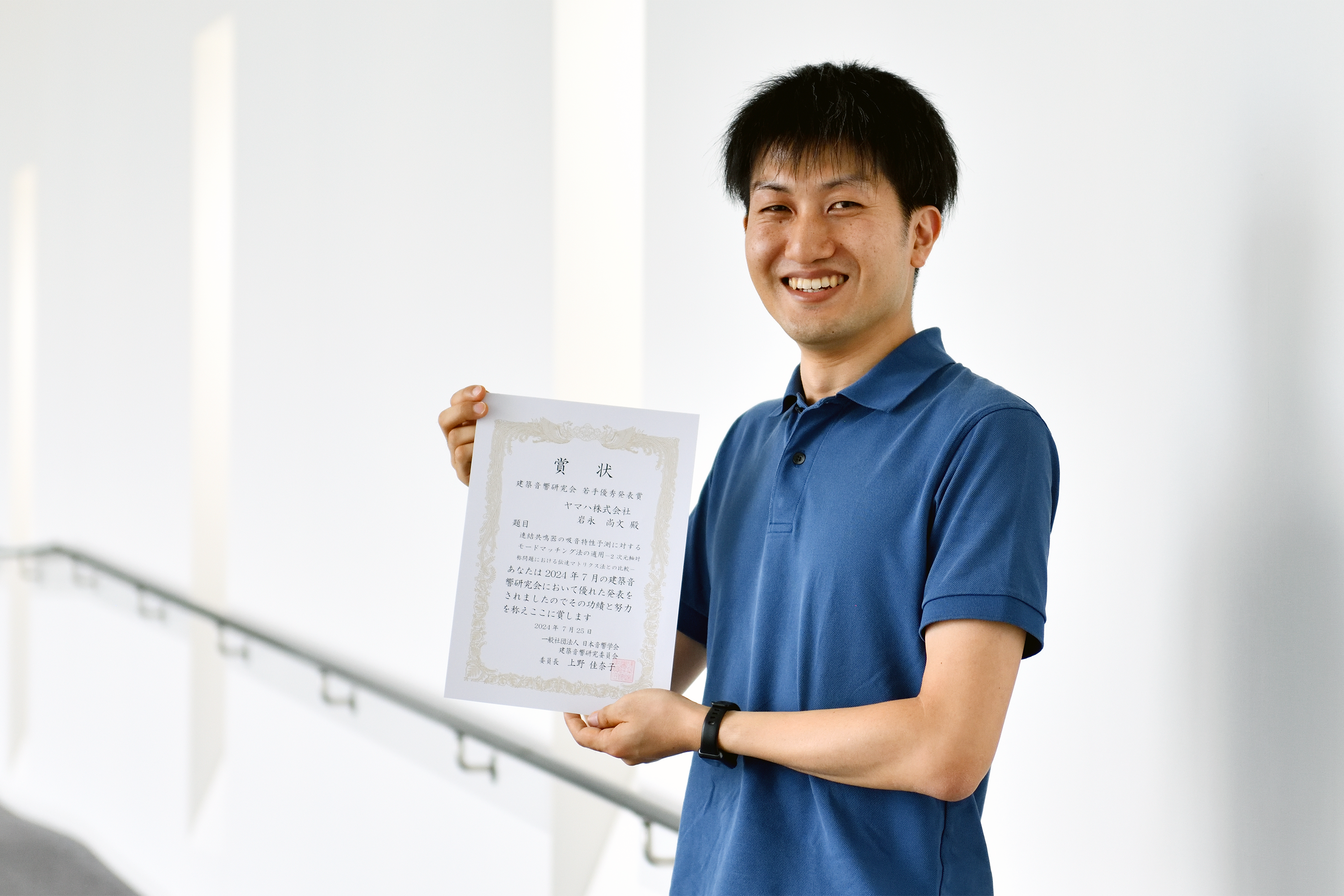
Awarded the Best Young Presenter Award from the Architectural Acoustics Technical Committee of the Acoustical Society of Japan
Awarded the Best Young Presenter Award in Simulation Technology for Sound Absorption Characteristics
Naoaki Iwanaga of the Research and Development Division was awarded the “Best Young Presenter Award” at the July 2024 Architectural Acoustics Technical Committee of the Acoustical Society of Japan.
The Best Young Presenter Award is given to young researchers who have made particularly outstanding presentations to the Architectural Acoustics Technical Committee of the Acoustical Society of Japan.
・Title of presentation : Application of the mode-matching method to the prediction of the sound absorption characteristics of coupled resonators – Comparison with the transfer matrix method in the case of two-dimensional axisymmetric problems –
・Summary of presentation : The mode-matching method, which is used for the wave analysis of waveguides, was applied to the analysis of coupled resonators consisting of multiple Helmholtz resonators connected in series. In this report, after providing an overview of the theory of the mode-matching method, we report on a comparative validation of the analytical accuracy of this method with the transfer matrix method, using finite element method solutions as the reference solution for two-dimensional axisymmetric problems. With the transfer matrix method, which assumes plane wave propagation, it is necessary to introduce an aperture edge correction at locations where the cross-sectional area changes discontinuously inside and outside the resonator. With the mode-matching method, however, it was confirmed that it is possible to predict the resonance frequency and sound absorption coefficient with the same accuracy as the finite element method without introducing an aperture edge correction.
Comment on receiving this award
We are developing a design method for a resonator-type sound-absorbing structure. Sound-absorbing structure is one of methods for adjusting the sound resonance in a room. We reported our core simulation technology for sound absorption characteristics.
The mode-matching method has been used in the electromagnetic wave analysis and acoustic analysis of the vocal tract. Our new approach makes it possible to predict the sound absorption characteristics of resonators with high accuracy and at low computational cost, which has been an issue in the past. I am very happy that our research has garnered interest.
We will continue to contribute to the development of simulation technology in order to solve various issues related to acoustic environments.
Naoaki Iwanaga(Research & Development Division Core Technology Research Department Simulation & Analysis Group)